What are the public holidays until the end of the year?
If you are planning your stay in Spain, it is important to know the public holiday calendar. On these dates, public administrations, banks and many shops and businesses may be closed, so knowing these days in advance will help you organise your stay better and plan activities to enjoy your time with family and friends.
In Spain, there are up to 14 public holidays each year, combining national, regional and local holidays.
Public holidays from September to December 2026
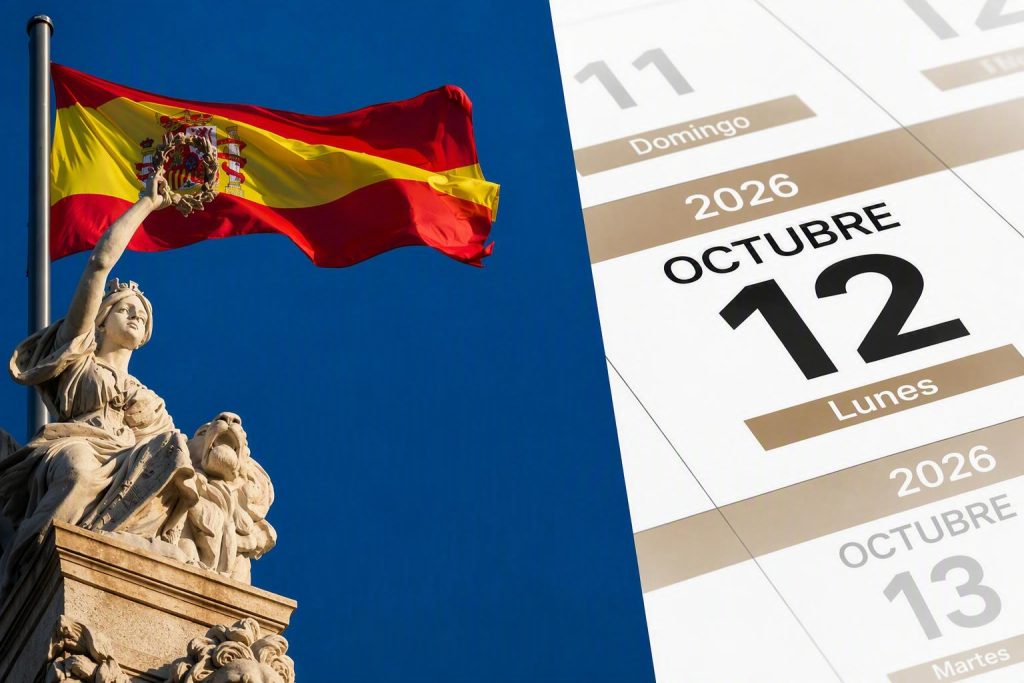
October, 12th
Spain’s National Day
Spain’s National Day is celebrated every year on 12 October. The date is historically associated with Christopher Columbus’s arrival in the Americas in 1492 and is now also one of the country’s main official celebrations.
The date also coincides with the Feast of Our Lady of the Pillar (Virgen del Pilar), one of the most traditional religious celebrations in Spain. The Virgin of the Pillar is the patron saint of Hispanic peoples and is particularly associated with the city of Zaragoza, where major celebrations take place every year, and the Guardia Civil
November, 2nd
All Saints’ Day
All Saints’ Day has religious origins and is traditionally dedicated to remembering deceased relatives and loved ones. During this period, it is customary to visit cemeteries to clean and decorate graves.
It is also a time associated with a wide variety of traditional pastries, including huesos de santo (saint’s bones), buñuelos de viento (wind fritters) and panellets, as well as many local specialities.
In 2026, November, 1st falls on a Sunday, so the public holiday is moved to Monday, 2 November, in Andalusia and in other regions of Spain.


DECEMBER, 7TH
SPANISH CONSTITUTION DAY
Constitution Day commemorates the referendum held on 6 December 1978, when the Spanish people approved the Constitution that is still in force today.
In 2026, 6 December falls on a Sunday, so the public holiday is moved to Monday, 7 December, in Andalusia and in other regions of Spain.
DECEMBER, 8TH
INMACULATE CONCEPTION
The following day is the Feast of the Immaculate Conception, a Catholic religious holiday dedicated to the Immaculate Conception of the Virgin Mary. It is a long-standing tradition in Spain and is particularly significant in many towns, cities and institutions.

DECEMBER, 25th
CHRISTMAS DAY
25 December is Christmas Day. Although Christmas Day itself is the public holiday, family celebrations usually begin the evening before, on 24 December, Christmas Eve.
It is one of the main family celebrations of the year, traditionally accompanied by special meals and dinners, traditional sweets and Christmas carols.
And then comes the Three Kings period
Although the 2026 calendar ends on 31 December, it is worth bearing in mind that in Spain the Christmas period traditionally continues until 6 January.
There are two additional public holidays during this period:
- 1 January 2027 – New Year’s Day
- 6 January 2027 – Three Kings’ Day or Epiphany
6 January is particularly important for families and children, as it is traditionally the day when the Three Kings bring presents. On the evening before, 5 January, many cities and towns also hold the traditional Three Kings parades (Cabalgatas de Reyes).
Would you like to know the public holidays in your local area?
In addition to national and regional public holidays, some towns and cities have their own local holidays.
Would you like to know the public holiday calendar for your local area?
At Expatcenter.info, we can provide you with this information. Fill in the form and we will send you the public holiday calendar for your local area.